RG-L001 · Generator
Siemens generator (covered)
A detailed replica of a Siemens generator on its transport frame, shown covered. Sits permanently on transport beams and fits every RailGut Base.

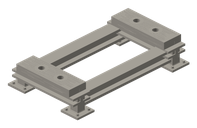
CAD renderings of the Base and Load.
- Length
- 90 mm
- Width
- 23 mm
- Height
- 27 mm
- Scale
- H0 · 1:87
Features
Features
- Highly detailed model
- Four integrated pins for the RailGut interface
- With transport beams and mounting points
- Realistic weathering or base grey to paint yourself
Applications
Applications
- Power supply
- Power stations
- Heavy transport
- Plant construction
- Model railways and dioramas
Dimensions (approx.)
Dimensions (approx.)
Schematic envelope dimensions in millimetres.
Details
Details


Background
The Siemens name
Siemens goes back to 1847, when Werner von Siemens and Johann Georg Halske founded a telegraph workshop in Berlin. In 1866 Werner von Siemens discovered the dynamo-electric principle, an important step towards the generators that power stations use today.
Railways and electricity share a history from the start: in 1879 Siemens & Halske presented the first electric railway powered from an external supply.
The RailGut generator is shown ready for transport on its beams, covered in L001 and uncovered in L002.
Sources: Siemens: history timeline
Compatible Bases
The same Load fits every RailGut Base.
- Base B006Märklin Lgjs 573 (4768, 4769, 4515, 47672, 47680, 47689) wagon
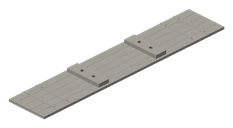
- Ground Base B007Reinforced wood and steel foundation – no wagon, for workshop, loading street and diorama
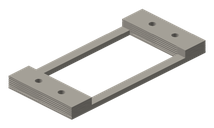
- Ground Base B008Concrete and wood storage foundation – no wagon, for workshop, loading street and diorama
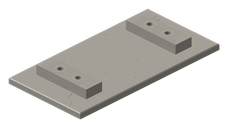
- Ground Base B009Steel storage trestle – no wagon, for workshop, loading street and diorama